Popular Posts

Caveat Emptor

The opinions expressed on this page are mine alone. Any similarities to the views of my employer are completely coincidental.

Monday, 10 May 2010

Journey's End

The Guardian's Michael White has written an excellent piece on Gordon Brown's career.

Election Special 2

I'm still finding it difficult to understand the political logic of Clegg's negotiations with Cameron. OK he has to be seen to go through the motions but we are past the stage where he has satisfied the proprieties. The main thing that Clegg's followers want is electoral reform -  the one thing he is not going to get from Cameron. That being so an arrangement - coalition or otherwise - with the Conservatives spells doom for the LibDems. If he settles for less - say an agreement to set up a body of worthies to look into it at some unspecified time in the future - he gets nothing apart from the opprobrium of being associated with an administration that once the cuts bite will be deeply unpopular. He will also be at the mercy of the Conservatives calling a snap election at a moment that is relatively favourable for their chances. My guess is that the LibDems would do badly in such an election. If he doesn't conclude a deal with either Cameron or Brown and allows the former to form a minority government then we will have an election very soon in which the LibDems will probably be severely squeezed. If people want a clear result they are not going to vote for a third party that can't, under the 1st past the post system, turn its apparent media popularity into seats. The least worst alternative for Clegg is a coalition with Labour. Such a government will be weak and it might not survive long enough to actually implement electoral reform. On the other hand the LiBDems will have a big incentive to make it work and it is the only chance they have to achieve their aim. My guess is that the Scots and Welsh nationalists can be offered some sweetners to play ball. It will all look pretty shabby, but hey it's politics, what do you expect?
An afterthought: if, as we are told, the parties should lay aside petty squabbles in the interest of dealing with economic doomsday, isn't it of some relevance that despite his overall unpopularity the public in the pre-election polls consistently rated Brown as the man they most trusted to deal with the economy?

The London Nobody Knows

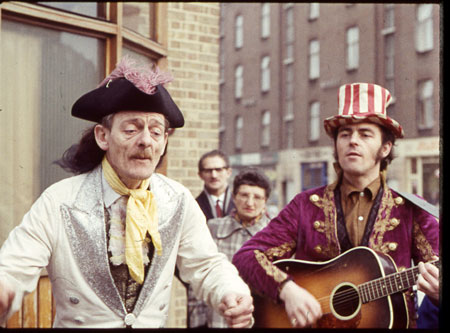
We watched a rather fascinating documentary on DVD at the weekend called 'The London Nobody Knows'. It was made in 1967 by Norman Cohen who went on to make, amongst other things, the film version of Dad's Army. The documentary, based on a book of the same title by Geoffrey Fletcher, is narrated by a rather phlegmatic James Mason and takes you on a tour of out of  the way corners of London that were fast disappearing. I particularly liked the part on the East End - the kosher grocery store, the already closed Yiddish theatre, pie and mash, eels and liquor. 

One section of it focuses on some street entertainers one of whom, the man on the left wearing the tricorn, looks remarkably like a rather broken down old gentleman who in the early 80s used to perform a  pathetic soft shoe shuffle outside the entrance to the Westgate Centre on Queen Street. I wonder if they are one and the same person?

Friday, 7 May 2010

Election Special

It's obvious that everything is still up for grabs. I find it difficult to imagine though why Clegg would do a deal with Cameron for anything less than a referendum on PR. If you are going to drop the main planks of your economic policy and shackle yourself to an inevitably unpopular government you want to make sure you get something tangible out of it. Cameron can't concede PR without alienating a large section of his party. You can see their point. Unless we see big changes in the ideological positions of the parties PR would probably have the effect of keeping the Conservatives, as we know them,  almost permanently out of power. Of course sections of the party - perhaps the pro Europeans -  may, under a PR system, splinter off into something like a mainsteam conservative christian democratic party. One could imagine the same sort of splintering  forces might also operate on the other parties, for example  an Old Left redistributive but socially conservative party allied with the trade-union movement might hive itself off from New Labour. Labour is the only party that is going to offer Clegg anything like what he really wants. Of course such a coalition will itself become massively unpopular after it does what it has to do to reduce the deficit, but it is better for the LibDems to be unpopular with electoral reform than without it. If electoral reform is implemented it will be a whole new ball game. My guess is that Clegg would  acquiesce to a  Brown premiership if he could achieve that sort of change.

Tuesday, 4 May 2010

The abuses of literacy

One of the books I read over the Easter vacation was A Sort of Clowning: Life and Times 1940-1959 the second volume of Richard Hoggart's autobiography. One of the instructive stories it contains is about an incident of student plagiarism that occurred whilst he was teaching at Rochester in the late 1950s:
"I marked an essay on Yeats which was not only pathetic in its near-illiteracy but plainly full of plagiarisms. The man had been stupid enough to go to the library and copy in a still unformed hand whole paragraphs from different critics. The essay was like a dish made up of elements of haute cuisine embedded in a large inferior hamburger."
The student had no conception of what he had done wrong even after it was explained to him and this lack of insight, Hoggart observes, was not just a personal failing, but, he opines, a direct result of the culture he swam in:
"That young man was baffled not just because he was not very clever but because his culture had not introduced him to  - had positively discouraged him from - the idea of intellectual discrimination, differences in intellectual grasp and ability. He could distinguish a cheap car from a better, and no doubt a good swimmer or runner from a mediocre. He had never been invited to understand that some minds may be better than others. He had been introduced not to the world of ideas but to that of opinions; and manifestly one man's opinions are as good as another's..." 
Essentially Hoggart's student lived in a pick-and-mix world in which scholarship was about assembling various  nuggets of  fact and judgment in a heap. How much worse things have become in the age of cut-and-paste. The best and worst that has been thought can now be  rapidly excerpted and arranged on the page by the most minimally literate with just the slightest matrix of discrimination.
Hoggart's The Uses of Literacy was the first sociology book I ever read. I remember as a sixth-former seeing it on a bookshelf and being puzzled by the title. Wasn't the use of literacy obvious? Apparently the original title was The Abuses of Literacy, but the publisher didn't like that. Nowadays to shift units a publisher would probably force him to call it something like: Why reading makes us all dummer or Why the media makes everything shite
Rereading Uses I'm struck by how little I must have understood of it. First published in 1957 the world Hoggart is describing in the first part of the book is mainly the working class culture of the North of England in the 1920s. That was already half a century ago in the 1970s when I first read him yet I could still identify at least some elements in the attitudes and the pattern of feelings he described that were true of my family and our neighbours. It  was the autobiographical parts that appealed to me the most; that and his description of the uprooted and anxious sensibility of the scholarship boy, an alien in some respects to his family but equally an outsider even in provincial intellectual middle-class circles.
The critique of  what in retrospect was just the beginning of the mass communications revolution and its effects on the cultural life of ordinary people passed right over my head. Of course Uses contains just the merest hints of what was to come and rereading it reminds one of how much the cultural revolution of the sixties changed everything - some things for the better, some for the worse. Where he is spot on is in his delineation of the self-serving cultivation of a form of top down populism among cultural elites (especially when they own or work for TV stations and newspapers) that legitimates a 'give em what they want' form of cultural democracy and the simultaneous disparagement of any attempt at cultural discrimination as mandarin elitism. Well, when advertising revenues are at stake they would say that wouldn't they?


When Romeo met Juliet

I caught Paul Roseby, artistic director of the National Youth Theatre, on Start the Week yesterday talking about about a forthcoming BBC documentary on a project he undertook with kids from two Coventry comprehensive schools to stage a production of Romeo and Juliet at the city's Belgrade Theatre.  By any stretch of the imagination this was a tough assignment, particularly as he seems to have gone out of his way to include teenagers who have no special affection for Shakespeare. I used to play hockey at one of the schools - Sidney Stringer - and it was the epitome of inner city toughness. You kept your wits about you in the changing room and tried not to look anyone in the eye. That was more than 30 years ago but I would guess it is still a school that has to deal with special challenges. I'm a bit ambivalent about the media hooplah that tends to surround this sort of thing - there is a tendency for "parachutists" to divert attention from the grassroots arts in the community work that is going on. But if it reminds us that the arts can be a part of ordinary people's lives and change those lives then that has to be a good thing particularly in the forthcoming austerity when  public support for the arts is going to be hard pressed.

Monday, 3 May 2010

Are we living in a simulation?

Last week I was clearing up a pile of paper on my desk and came across this cartoon that I had clipped out of the Stockholm edition of  Metro a few years ago. "'Do you want to see something cool? Stand in the light and bawl Booga-Booga!' Have you sometimes wondered how a new religion starts?" I don't remember now why I wanted to keep it. If Gods are rats then divine intervention might look like this and the humans in the maze would have good grounds for believing in rodent powers that are consequential for their lives. So no great social scientific insights here. But then I came across this - a set of philosophical conjectures by a colleague in the James Martin School that  takes seriously the idea that there is a positive probability that we may all be participants in a giant computer simulation set up by post-humans ( and a bigger probability that we are not). Life is frequently much weirder than art.